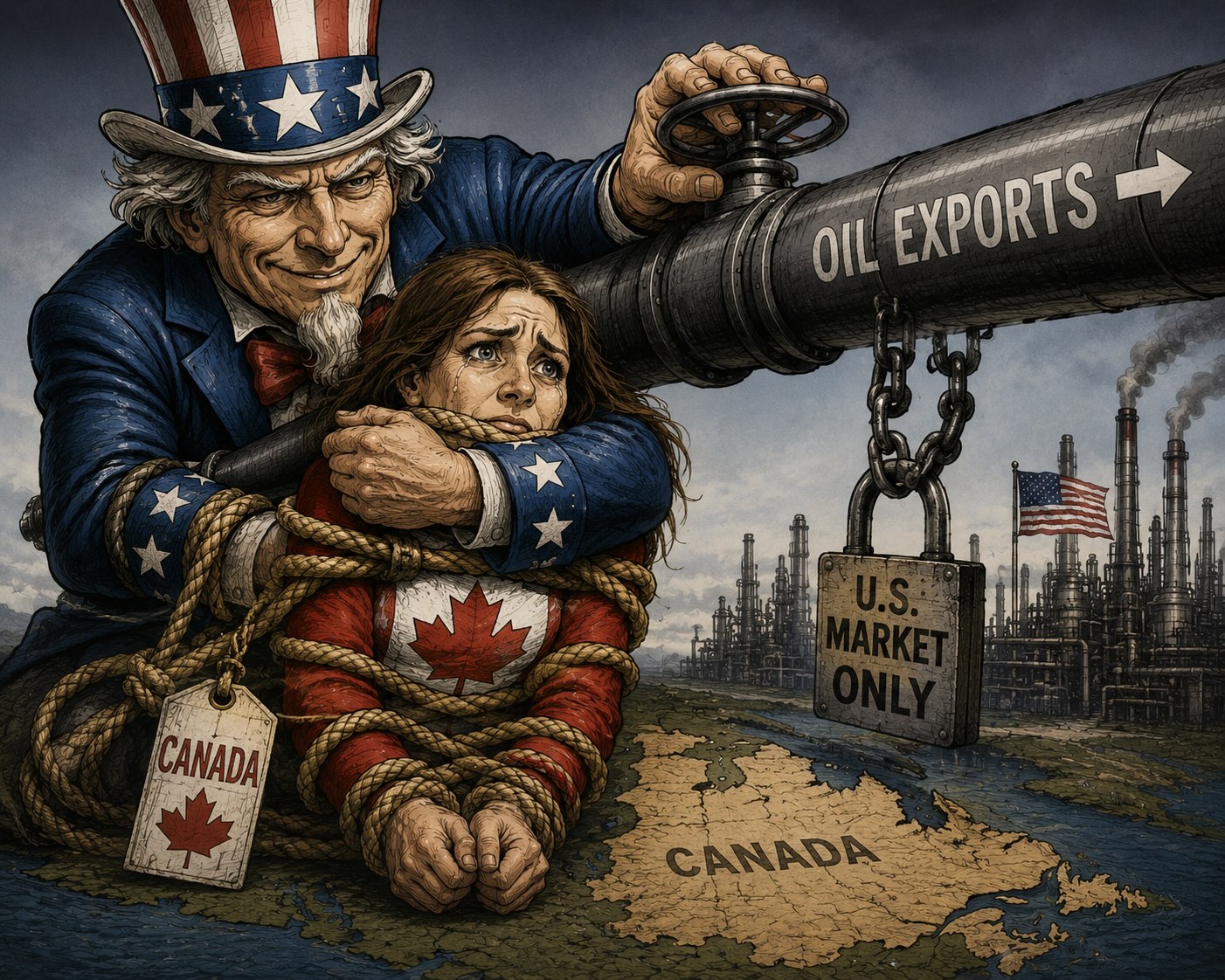

Oil Fleece

By Adam Corelli

President Donald Trump portrays Canada as a country that somehow “takes advantage” of the United States economically. Yet one of the most important energy stories of the past three decades suggests the opposite is true.

The U.S. has effectively fleeced Canada of as much as $300 billion in recent years over oil exports.

Canada possesses some of the largest oil reserves on Earth, particularly in the oil sands of Alberta. But despite this immense resource wealth, Canada has long faced a structural problem: it has had limited ability to export its oil beyond the United States.

For decades, inadequate pipeline access to ocean ports effectively trapped much of Canadian crude within the North American market, leaving the United States as the overwhelmingly dominant buyer.

Oil exports
Read
Trump Dali image

Canada's President?

If Canada were to join the United States as one or more states, the transformation would be profound—politically, culturally, and psychologically. The merger would not simply redraw a border; it would redefine the character of North America.

Politically, the most immediate impact would be electoral. Canada’s population of roughly 40 million would make it larger than California and comparable to the biggest U.S. states. Depending on how it were incorporated—whether as a single large state or divided into several—Canada would send a significant bloc to the House of Representatives and at least two senators per state to the Senate. If admitted as multiple